

By Nana, Sales Operations Manager at VINIC Brakes · Last Updated: 2026-07-30
High initial bite means the pad grips hard the instant you touch the brake pedal. For track driving, look for a compound rated μ 0.42–0.50 with a wide temperature range — like VINIC Sport pads (0–850°C) — where strong bite meets fade resistance.
Bite is only half the story. A pad with aggressive initial bite but poor modulation makes the car hard to balance on corner entry — one reason “too aggressive” is a common complaint in track communities. The right choice depends on your tires, whether the car has ABS, and how you drive. This guide breaks down what initial bite actually measures, how it differs from overall friction and modulation, how much bite is too much, and how to match a compound to your setup — with real specs from our Street and Sport compounds.
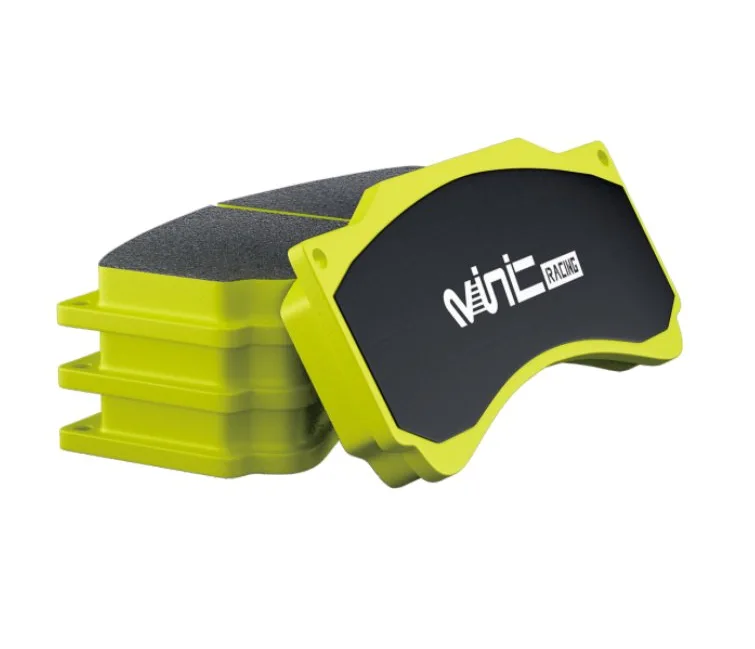
What Is Initial Bite in Brake Pads?
Initial bite is the friction a brake pad delivers in the first instant of pedal application — before the brakes carry heat, and before you press deep into the pedal travel. A pad with high initial bite responds immediately and firmly. A pad with low initial bite asks for more pedal before it starts working. Neither is automatically better; they suit different cars and different drivers.
Initial Bite vs. Overall Friction (μ)
Friction coefficient (μ) describes how strongly the pad grips across its working range. Initial bite describes when that grip arrives. Two pads can share a similar μ and still feel completely different at the top of the pedal, because their friction curves rise at different rates. In the US, pads may carry an SAE J866 friction code — two letters printed on the pad edge that bracket the measured coefficient, such as FF or GG. That code tells you the friction range, not the bite character.
Initial Bite vs. Modulation: Why You Need Both
Modulation is the ability to add or release braking force in fine, controllable steps near the grip limit. Bite gets you into the braking zone; modulation lets you trail off the pedal cleanly as you turn in. When drivers say a pad is “too aggressive,” they usually mean it has strong bite but poor modulation — the pad grabs, then gives you little control between some braking and too much braking.
Why Does Initial Bite Matter on Track?
Cold Bite in the First Braking Zone
At the start of a session, tires and brakes are both below their best working temperature. A pad that needs heat before it works will feel wooden on the first heavy stop of the day. A compound rated from 0°C — VINIC Sport pads work across 0–850°C — delivers usable bite from the first braking zone, while the tires are still coming up to temperature.
Pedal Feel and Confidence Under Repeated Load
Consistent bite builds confidence faster than raw friction does. When the pedal responds the same way lap after lap, you brake later and commit harder, because nothing about the car’s behavior surprises you. When bite changes as the brakes heat up, you spend mental energy managing the pedal instead of reading the track. Predictability is what turns a fast pad into a fast lap.
Can Brake Pads Have Too Much Initial Bite?
Yes — but always relative to the setup, never in isolation. Bite that feels perfect on a car with sticky tires and a well-calibrated ABS can feel like an on-off switch on a car with hard street tires and no ABS. The question is not “how much bite does this pad have,” but “how much bite can the rest of my car use.”
Signs Your Pads Are Too Aggressive for Your Setup
Watch for these patterns after a pad upgrade:
- The ABS intervenes earlier and more often than before, especially on cold tires
- The fronts threaten to lock when you brake firmly but not hard
- The car feels grabby at low speed — paddock, pit lane, or traffic
- Trail braking becomes difficult because the pad won’t release progressively
Any one of these means the pad’s bite has outrun what your tires, ABS, or technique can modulate.
Matching Bite to Tires, ABS, and Driving Style
Grippier tires tolerate more bite, because they convert that friction into deceleration instead of lockup. Cars without ABS need a progressive pad that lets your right foot do the regulating — with ABS, the electronics cover small errors in pedal application. Newer track drivers usually improve faster on a modulation-first compound: it forgives a heavy foot while the braking technique catches up.
How to Choose Track Brake Pads: 5 Factors Beyond Bite
Evaluate any track compound on five variables before you look at marketing claims:
- Friction range (μ) — how hard the pad grips across its range
- Temperature range — the span over which that friction stays stable
- Bite character — how quickly friction arrives at the top of the pedal
- Modulation and release — how precisely you can adjust pressure mid-corner
- Wear behavior — pad life and how kindly the compound treats rotors
Measured against those five variables, here is how our two compounds are positioned:
Street vs. Sport Compounds: A Quick Comparison
| Factor | VINIC Street | VINIC Sport |
|---|---|---|
| Friction coefficient (μ) | 0.40–0.46 | 0.42–0.50 |
| Working temperature | 0–650°C | 0–850°C |
| Bite character | Smooth, progressive | High initial bite, predictable modulation |
| Dust and noise | Low dust, low noise | Track-focused; dust and noise are secondary |
| Best for | Daily driving and spirited street use | Track days; street legal, track bred |
For a car that sees mostly road miles with occasional spirited driving, VINIC Street pads are the sensible choice. For regular track days, VINIC Sport pads are built for exactly the bite-plus-fade-resistance combination this guide describes. If you are preparing for your first event, our track day brake guide covers fluid, cooling, and the rest of the prep checklist.
Bedding and Heat Management for High-Bite Pads
New pads need proper bedding before they can deliver their rated bite. Bedding transfers an even layer of pad material onto the rotor face, which is what makes friction consistent from the first stop to the last. Skipping it — or doing a few lazy stops on the street and calling it done — typically shows up later as uneven response, vibration, or noise. Follow the step-by-step process in our brake pad bedding guide, and plan heat management for long sessions the same way you plan tire pressures.
FAQ
Do high initial bite brake pads stop the car faster?
Not by themselves. Total stopping force is limited by tire grip, so a high-bite pad will not shorten the absolute stopping distance on the same tires. What it changes is response: the car decelerates sooner after you move your foot, with less pedal travel. That immediacy is what most drivers perceive as “stopping faster.”
Are high-bite pads suitable for daily driving?
Usually a dedicated street compound suits daily driving better. Very aggressive bite can feel grabby in traffic and may come with more dust and noise than street-focused pads. Compounds like VINIC Street prioritize smooth, progressive response at everyday temperatures, which is what commuting actually rewards.
What friction coefficient (μ) should I look for in track pads?
There is no single right number — match μ to your tires, car weight, and whether the car has ABS. As a reference point, VINIC Sport pads run μ 0.42–0.50 across a 0–850°C range, which suits typical track-day cars on performance tires. More μ than your tires can use just reaches lockup or ABS intervention sooner.
Do high-bite pads wear rotors faster?
More aggressive compounds generally trade some rotor friendliness for their friction and temperature performance. That is normal across the industry, not a defect. If rotor life is a priority — for example, on a daily-driven car — a milder street compound is the more economical choice over time.
Do I need to bed in new track pads?
Yes. Bedding deposits an even transfer layer of pad material on the rotor, and that layer is what makes bite consistent under repeated hard stops. Unbedded pads commonly feel uneven and can develop vibration. The full street and track procedures are in our bedding guide, linked above.
Can I run high-bite track pads with stock calipers?
In most cases, yes — pad compound and caliper hardware are separate choices. If the pad shape matches your caliper, a track compound works with factory brakes. Confirm the exact shape for your vehicle before ordering; free fitment confirmation checks your model year and specs before you buy.
The Bottom Line
Initial bite is how quickly a pad answers your foot; modulation is how well you can steer that answer. Fast track driving needs both, matched to your tires, your ABS, and your current skill as a driver. As of July 2026, our recommendation for dedicated track use is a compound rated μ 0.42–0.50 with a temperature range to 850°C — the VINIC Sport specification.
Ready to Choose Your Track Pads?
Send us your model year and wheel specs, and we will confirm the exact pad shape and compound for your car — free, within one business day.