

Towing changes the physics of braking more than any other thing you can do to a vehicle. Bolt a 5,000 lb trailer behind a half-ton truck and every downhill stop must convert roughly double the kinetic energy into heat — through pads that were engineered for the truck alone. This guide explains what towing actually demands from a brake pad, the criteria that matter (and the ones that are marketing), and how to choose a compound that will still be biting at the bottom of the grade.
The Short Answer

The best brake pads for towing are heavy-duty semi-metallic compounds with a high, stable friction coefficient at temperature and a fade ceiling well above what a street pad offers. Ceramic-style street pads — excellent for commuting — run out of thermal headroom under sustained towing loads. For frequent heavy towing, pair the right pads with fresh fluid, and consider larger rotors or a big brake kit to add thermal mass.
Why Towing Destroys Ordinary Brake Pads
A brake pad’s job is energy conversion: motion becomes heat. Double the moving mass and you roughly double the heat per stop — but the rotor’s ability to absorb and shed that heat stays the same. The excess piles up in the pad itself. Push a street compound past its thermal ceiling and three things happen in sequence: the resin binder begins to break down and outgas, creating a gas film between pad and rotor (that is fade — the pedal feels normal but the car does not slow); the friction surface glazes into a hard, low-grip skin; and wear accelerates from years to months.
The dangerous part is that fade under load is a compounding problem: the trailer’s momentum keeps pushing, each stop is hotter than the last, and a long descent can take a marginal setup from “fine” to “no brakes” inside a few miles. Choosing a towing pad is about buying temperature headroom before you need it.
The Selection Criteria That Matter
| Criterion | Why It Matters for Towing | What to Look For |
|---|---|---|
| Fade temperature / operating window | Determines where the compound gives up | A rated window reaching 600–850°C, not just “high performance” claims |
| Hot friction stability | Bite must stay consistent as rotors heat soak | A flat μ curve across the window — bench-tested data beats adjectives |
| Friction level (μ) | Higher μ means less pedal force for the same stop | μ 0.42–0.50 territory for heavy loads |
| Thermal conductivity | Moves heat from the pad face into the backing plate | Metallic fibers in the matrix — the semi-metallic advantage |
| Wear rate under heat | Towing eats soft compounds | Heavy-duty formulations rated for truck/SUV duty |
| Cold manners | The rig still drives to the boat ramp unloaded | Acceptable cold bite; some dust/noise trade-off is normal |
Why Semi-Metallic Wins for Towing
Compound chemistry decides nearly everything on that list. Ceramic-style street compounds are quiet, clean and kind to rotors — but their resin-bonded matrix has a thermal ceiling around the top of street duty, and towing lives above it. Semi-metallic compounds embed steel, iron and copper fibers in the friction matrix. Those fibers do three jobs at once: they hold friction stable at temperatures that degrade ceramic binders, they conduct heat away from the rotor interface, and they resist the glazing that kills bite on long descents.
The trade-offs are real but manageable: more dust, some cold noise, and slightly faster rotor wear. For a vehicle that tows, those are the right concessions. Quiet wheels do not matter at the bottom of a mountain grade; stopping does. Our own tow-oriented recommendation follows exactly this logic — a bench-tested semi-metallic sport compound rated 0–850°C with μ 0.42–0.50, which keeps full bite through the kind of sustained heat a loaded descent generates. We break the compound choice down further on the off-road & towing page.
Matching the Pad to How You Tow
Occasional light towing (small utility trailer, a few times a year)
A quality heavy-duty street/semi-metallic hybrid compound is enough. Prioritize cold manners and low noise for the 95% of miles you drive unladen.
Regular towing (boat, camper, car trailer — most weekends)
Step up to a true heavy-duty semi-metallic. Accept the dust. Inspect pad thickness before every long trip, and bed new pads in properly before the first loaded run — an uneven transfer layer under towing heat is a judder waiting to happen (see our bedding procedure).
Heavy or mountain towing (enclosed trailers, 5th wheels, long grades)
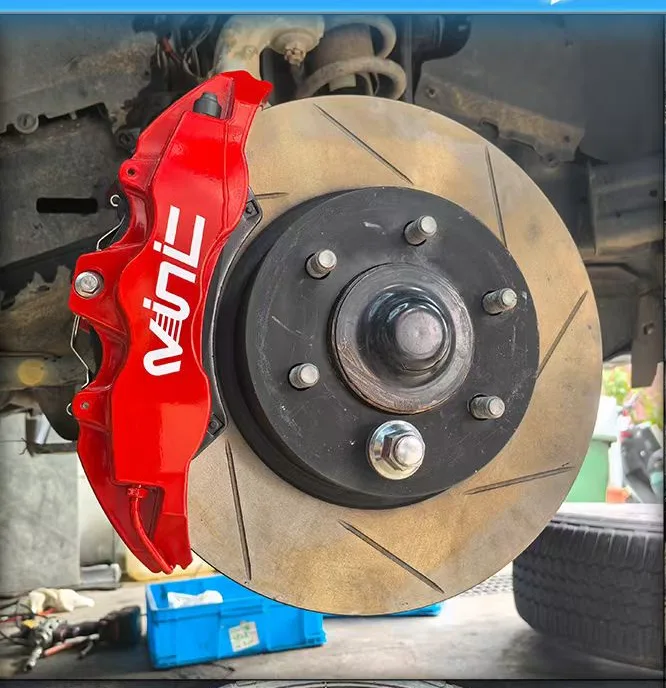
Pads alone stop being the answer at this level — you need thermal mass. Bigger rotors absorb more heat per stop and multi-piston calipers clamp more evenly across larger pads. This is big brake kit territory: our kits pair forged 7075-T6 multi-piston calipers with 285–420 mm high-carbon rotors, performance pads and braided stainless lines, with brackets 3D-scanned to your specific truck or SUV. If your tow rig is fading with good pads already fitted, that is the permanent fix.
One often-missed detail for trailers with electric brakes: set the brake controller gain correctly on every trip. Too little gain and the truck’s brakes absorb the trailer’s share of every stop — the exact overload this guide is about. Too much and the trailer’s wheels lock and flat-spot tires. The correct setting has the trailer pulling its own weight, felt as a slight firming of the outfit under braking rather than a push.
Beyond the Pads: The Towing Brake Checklist
- Brake fluid: old fluid with absorbed water boils far below its rated temperature. Flush before towing season — boiled fluid means a pedal on the floor with perfect pads.
- Rotor condition: measure thickness; a thin rotor holds less heat. Slotted high-carbon rotors shed gas and resist cracking under tow heat.
- Trailer brakes: verify the trailer’s own brakes and breakaway system work; they should carry their share of the load.
- Tires and bearings: dragging trailer wheel bearings add rolling resistance the truck’s brakes must overcome on every descent.
- Technique: downshift on grades. Let the engine hold speed so the brakes stay in reserve for actual stops.
FAQ
Are ceramic or semi-metallic brake pads better for towing?
Semi-metallic, decisively. Towing generates sustained temperatures above a ceramic-style compound’s comfort zone, where it fades and glazes. Semi-metallic pads hold friction at those temperatures and conduct heat away from the rotor. Ceramic-style pads remain the better choice for unladen daily driving.
Do I need to upgrade my truck’s brakes to tow?
For occasional light towing within the vehicle’s rated capacity, a heavy-duty pad and fresh fluid usually suffice. For frequent or heavy towing — especially in mountains — upgrading rotors and calipers adds the thermal mass that pads alone cannot provide.
How long do brake pads last when towing regularly?
Expect roughly half normal pad life: 15,000–30,000 miles on the tow vehicle’s front axle with a suitable heavy-duty compound, less with a standard street pad. Inspect before every major trip.
What are the signs my brakes are fading while towing?
A pedal that feels firm but produces less slowing, increasing pedal travel, a burning smell, and needing progressively harder pedal pressure on a descent. If you notice any of these: downshift, stop safely, and let the brakes cool — do not continue the descent on faded brakes.
Get a Quote Built Around Your Car
Tell us your year, make and model — we confirm fitment first, then quote. No guesswork, no wrong parts.