

Whether you are planning a Saturday DIY session or deciding if the shop’s “we’ll have it this afternoon” is realistic, the time question has a refreshingly concrete answer. Brake pad replacement is one of the quickest jobs in car maintenance — but “quick” depends on which axle, whether rotors are involved, and a handful of complications that can double the clock. Here is the full breakdown.
The Short Answer

A professional shop typically replaces brake pads in 30 minutes to 1 hour per axle — about 1 to 1.5 hours for the whole car. A first-time DIYer should budget 1 to 2 hours per axle including setup; an experienced home mechanic does it in 30–45 minutes. Add rotors and each axle gains roughly 15–30 minutes. Then add 15 minutes everyone forgets: the bed-in drive.
Time Breakdown by Job
| Job | Professional Shop | Experienced DIY | First-Time DIY |
|---|---|---|---|
| Front pads only | 30–60 min | 30–45 min | 1–2 hrs |
| Rear pads only | 30–60 min | 30–45 min | 1–2 hrs |
| All four corners, pads | 1–1.5 hrs | 1–1.5 hrs | 2–4 hrs |
| Pads + rotors, one axle | 45–90 min | 45–60 min | 1.5–2.5 hrs |
| Full big brake kit install | 3–5 hrs | 3–4 hrs | 5–8 hrs |
Shop times assume the car is on the lift and parts are on hand. DIY times include jacking, stands and cleanup — the actual wrenching is often the shortest part.
Where the Minutes Actually Go

Front pads: the straightforward one
Front brakes are usually a floating-caliper design: two guide-pin bolts, the caliper lifts off, old pads out, piston pressed back, new pads in, reassemble. On a clean, rust-free car this is genuinely a 20-minute wrench job per side. The piston retract — pushing it back into its bore to make room for the thicker new pads — is the only step that surprises first-timers; a C-clamp or piston tool and slow, even pressure is all it takes. Keep an eye on the fluid reservoir so it does not overflow as the piston displaces fluid.
Rear pads: same job, one potential twist
Rear brakes are mechanically similar but carry a complication on many modern cars: the electronic parking brake. The rear caliper pistons must be retracted electronically — via a scan tool or the car’s service mode — before the pads come out. The procedure takes minutes once you know it; discovering it mid-job with the car on stands is how a one-hour job becomes three. Check your model’s service procedure before the wheels come off.
Adding rotors
Rotors add one bracket, two bolts and (on some cars) a small retaining screw per corner — plus wrestling a possibly rust-sealed disc off the hub. Figure 15–30 extra minutes per axle, more if corrosion is involved. This is also the moment to inspect what a pad-only swap skips: hub condition, dust shields, and the slide-pin boots.
What Adds Time (The Usual Suspects)
- Rust and seized fasteners: snow-belt cars can turn every bolt into a penetrant-and-patience exercise. This is the number-one schedule killer.
- Electronic parking brake: rear axles on most post-2015 European and many Asian cars need service mode. Know it before you start.
- Wear sensors: European cars route a sensor wire into the pad; it adds a few careful minutes and the sensor itself should be replaced if tripped.
- Stuck caliper or slide pins: if a pin is seized, the fix — cleaning, re-greasing or replacing — is worth the time, because it is also the cause of your uneven pad wear.
- First-timer learning curve: watching two tutorials and laying out tools beforehand reliably halves the job.
A realistic tools list keeps the clock honest: floor jack and two rated stands, a lug wrench or impact, a socket set, a C-clamp or piston retract tool, brake cleaner, high-temperature grease, a torque wrench for the lug nuts and caliper bolts, and a drain pan under the reservoir. Laying all of it out before the car goes up is worth a solid twenty minutes — mid-job hardware-store runs are where afternoon projects become evening ones.
DIY vs Shop: Choosing by the Clock
If your goal is pure speed, a shop with a lift wins — drop the car, answer email for an hour, drive out. If your goal is saving the $200–$500 of labor that a full-car pad job bills (see our brake pad replacement cost breakdown), DIY pays well per hour even at first-timer pace. The honest middle: DIY the fronts, which are simple, and hand the rears to a shop if your car has an electronic parking brake and you lack a scan tool.
One timing note that saves comebacks: if the old pads wore unevenly — inner pad thinner than outer, or one side of the car ahead of the other — add fifteen minutes to clean and re-grease the caliper slide pins, or replace them if the boots are torn. Uneven wear is the caliper telling you it was dragging; new pads on a sticky caliper simply repeat the pattern on an accelerated schedule.
The 15 Minutes Everyone Skips: Bedding
The job is not done when the wheels are torqued. New pads need a bed-in — a series of controlled stops that transfers an even friction layer onto the rotor — or you will be back under the car chasing squeal and judder within weeks. It takes about ten to fifteen minutes of driving: 6–10 moderate stops from 60 to 15 mph with cooling gaps, a couple of firmer stops, then a cool-down cruise. The full procedure is in our brake pad bedding guide. Schedule it into your afternoon; it is part of the job, not an optional extra.
If You Are Installing an Upgrade Instead
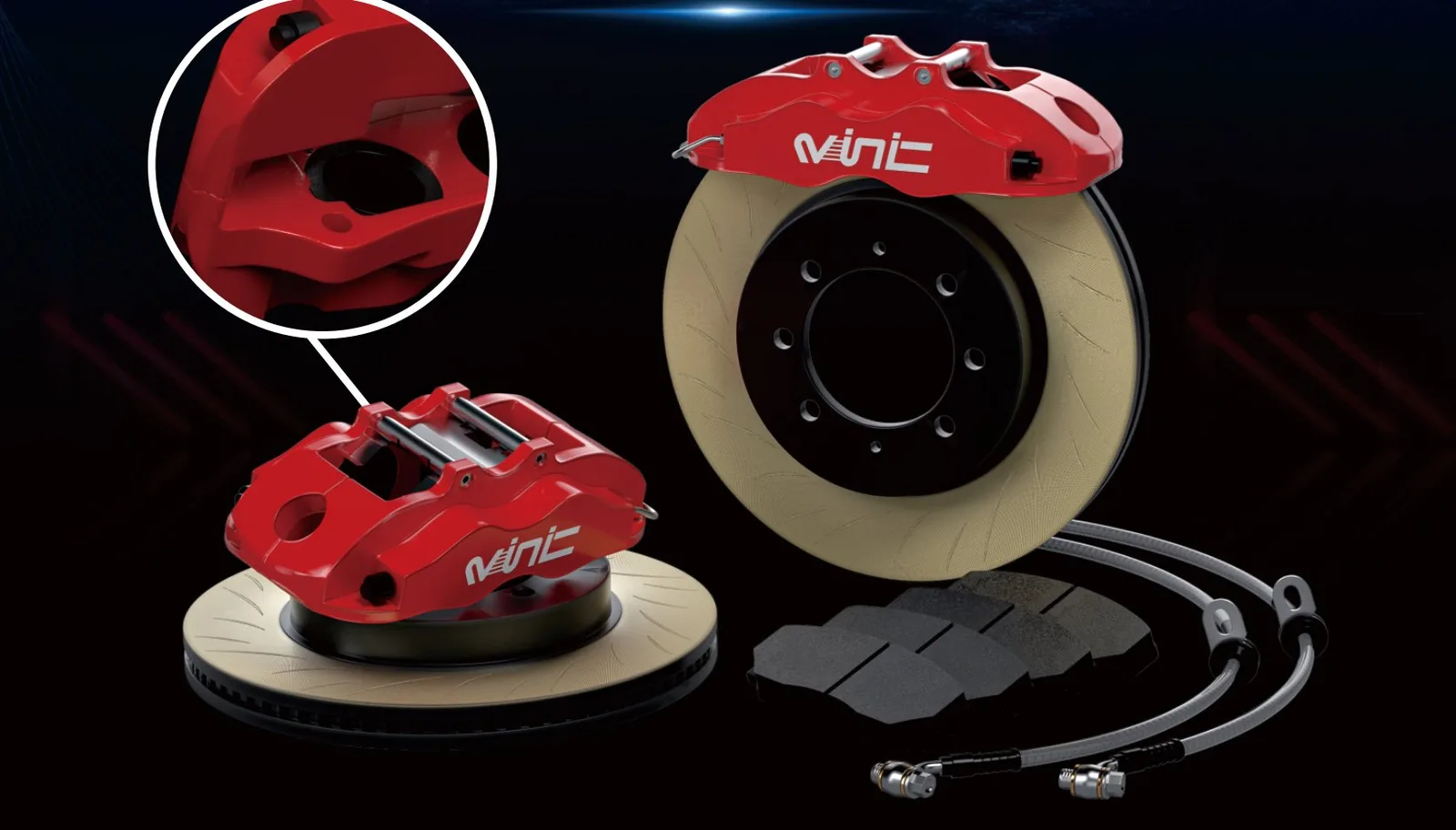
Swapping to a big brake kit follows the same logic on a bigger scale: calipers, rotors, pads, lines and brackets per corner. Because our kits are engineered per vehicle — brackets 3D-scanned to the specific model, lines cut to length — there is no fabrication, just bolt-on work and a fluid bleed. A shop typically bills 3–5 hours; a competent DIYer with a lift-free garage should plan a full day including the bleed and bed-in. More guides live on our Guides page.
FAQ
How long does it take a mechanic to change brake pads?
Typically 30 minutes to an hour per axle on the lift — call it 1 to 1.5 hours for all four corners, pads only. Adding rotors or fighting corrosion stretches each axle toward 90 minutes.
Can I replace brake pads myself in an afternoon?
Yes — a first-timer can do all four corners in 2 to 4 hours with basic hand tools, and the front axle alone in about an hour. Budget extra time if your car has an electronic parking brake, and finish with the bed-in drive.
Why does the shop quote say “all day” for a one-hour job?
Scheduling, not wrenching. The billed labor is an hour or two, but your car queues behind others. Ask whether they offer a wait-service slot — many shops will turn a pad job around while you wait.
How long after replacing pads can I drive normally?
Immediately — gently. Complete the bed-in procedure on the way home, then give the pads 200–300 easy miles before hard stops, track use or towing. The transfer layer needs that time to fully stabilize.
Get a Quote Built Around Your Car
Tell us your year, make and model — we confirm fitment first, then quote. No guesswork, no wrong parts.